Myofunctionals & KFO

 - 

31

.

01

.

26

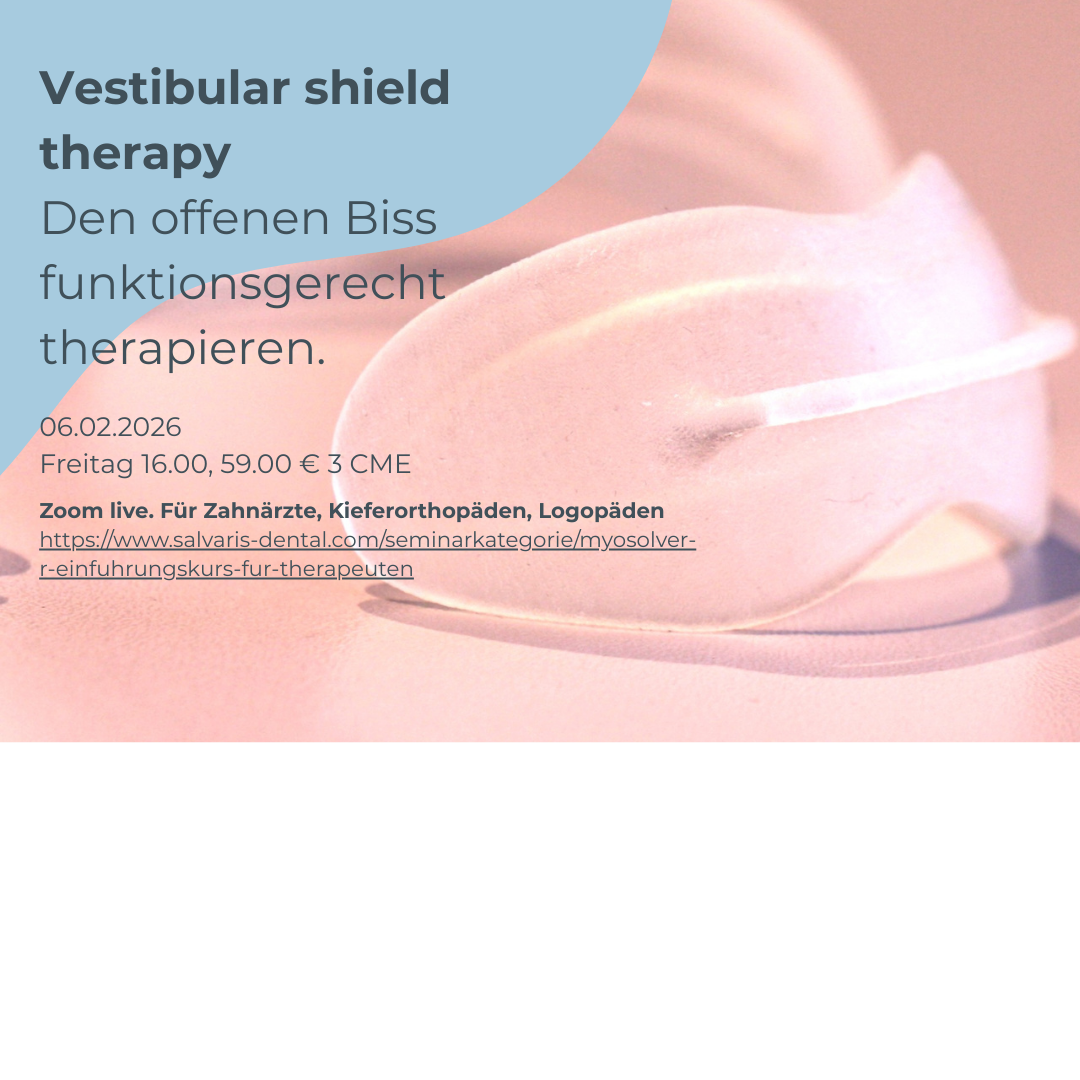
Vestibular shield therapy


Vestibular shield therapy solves open bite cases and mandibular retrusion myofunctionally by reestablishing negative pressure in the oral Donders space, which in turn repositions the tongue and lower jaw.

Consider incorporating vestibular shield therapy as a potential addition to your treatment plans and methodologies in

∙ orthodontics
∙ myofunctional therapy, speech and breath therapy
∙ sleep dentistry and
∙ TMJ-treatment.

Find out more about Myosolver®, the new soft, anatomically shaped vestibular shield.

Myosolver®/ Dentrade - made in Germany.

Myosolver® Indications

1) In orthodontics“vestibular shield therapy”

∙  Prevention and interceptive therapy for schoolchildren aged 7 and over, in early orthodontic treatment in cases of open bite, proclined incisors, mandibular retrusion, myofunctional disorders, orofacial dysfunction, parafunctional habits, and dysfunctions of the tongue, cheeks, and lips, and transversely underdeveloped dental arches (“Fränkel effect”).

∙  Single orthodontic treatment in cases where regular systematic orthodontic treatment is not possible, such as in cases of open bite, proclined incisors, mandibular retrusion, myofunctional disorders, orofacial dysfunction, parafunctional habits and dysfunctions of the tongue, cheeks and lips, and transversely underdeveloped dental arches (“Fränkel effect”), when regular systematic orthodontic treatment is not possible.

As part of systematic orthodontic therapy, in combination with or alternating with treatment algorithms, e.g. with aligners, MBA (brackets), removable appliances (appliance without a labial arch), bimaxillary appliances (appliance without a labial arch); used in cases of open bite, proclined incisors, mandibular retrusion, myofunctional disorders, orofacial dysfunction, parafunctional habits, and dysfunctions of the tongue, cheeks, and lips, transversely underdeveloped dental arches ("Fränkel effect") and forced lateral bite to rehabilitate the centric physiological mandibular position.

Training device for improving the patient´s awareness of tongue position and function, for exercises as part of orthodontic therapy.

∙ As a protective coverage shield for the lips and buccal mucosa toprevent injuries e.g. caused by brackets, hooks or TADs.

∙ As a protective lip seal shield for the teeth against dehydration/dryness caused by habitually keeping the mouth open, and to protect tooth alignment against parafunctional and dysfunctional forces; breaking parafunctional oral habits.

∙ A playful substitute device to help children break habits (thumb sucking or pacifier use).


2) In myofunctional/ speech therapy and osteopathy – “vestibular shield therapy”

∙  Treatment of tongue dysfunction, myofunctional and orofacial disorders, oral parafunctions and dysfunctions

∙  Training device for:

- training the patient's awareness of tongue position

- training lingual coordination and function

- home exercises as part of therapy

- orofacial dysfunction (OFD)

- nasal breathing exercises

- postural exercises

∙  People with disabilities can also use it to train their oral muscles and improve perception. 


3) In sleep dentistry and Otolaryngology

∙  Treatment of the mandibular retraction during sleep

∙  OSAS – Obstructive Sleep Apnoea Syndrome: an accompanying measure during mandibular advancement device (MAD) therapy for obstructive sleep apnoea; relief in cases of habitually open mouth with MAD

∙  Snoring: Single-sided or in combination with other devices used for treating snoring problems

∙  OSAS - Obstructive Sleep Apnoea Syndrome: Long-term use as an alternative to MAD for patients who have exhausted other treatment options;

option for CPAP- and MAD-intolerance

∙  Mouth breathing: Restoring and practising mouth closure in cases of habitually open mouth


4) In dentistry

∙  Support in TMJ (Temporomandibular Joint Disorder) therapy in cases involving pathological muscular or myofunctional aspects;

relief of the temporomandibular joints and masticatory muscles

∙  Accompanying measure to restore physiological functional processes to support centric mandibular positioning in cases of TMJ resulting from a lateral forced bite; accompanying measure for dissolving  adapted lower jaw posture in HIKP (habitual maximum tooth occlusion)

∙  Adjunctive measure during splint therapy

∙  Training device for improving tongue awareness and function in pathological orofacial situations, and for home exercises as part of temporomandibular joint therapy


5) Non-medical application:

∙  Learning to breathe through the nose; in cases of habitual mouthbreathing, habitual open mouth at night, and occasional snoring problems caused by a retracted mandible and tongue

∙  Orofacial dysfunction; oral parafunctions and dysfunctions, high muscletone of the lip and tongue

∙  Breaking oral habits

∙  Support for postural training

Myosolver® Indikationen (German):

1)     In der Kieferorthopädie - „vestibular shield therapy“

§ Prävention und interzeptive Therapie bei Schulkindern ab 7 Jahren, in der kieferorthopädischen Frühbehandlung bei frontal offenem Biss, proklinierten Schneidezähnen, Unterkiefer-Rücklage, myofunktioneller Störung, orofazialer Dysfunktion, Parafunktionen und Dysfunktionen der Zunge, der Wangen und der Lippen, bei transversal unterentwickelten Zahnbögen („Fränkel-Effekt“).  

§ Singuläre kieferorthopädische Therapie bei frontal offenem Biss, proklinierten Schneidezähnen, Unterkiefer-Rücklage, myofunktioneller Störung, orofazialer Dysfunktion, Parafunktionen und Dysfunktionen der Zunge, der Wangenund der Lippen, bei transversal unterentwickelten Zahnbögen („Fränkel-Effekt“), wenn eine reguläre systematische kieferorthopädische Therapie nicht möglich ist.

§ Im Rahmen der systematischen kieferorthopädischen Therapiein Kombination oder alternierend mit den Maßnahmen der Behandlungsalgorithmen,z.B. mit Alignern, MBA (Brackets), herausnehmbaren Apparaturen (Gerät ohne Labialbogen), bimaxillären Apparaturen (Gerät ohne Labialbogen). Zur Anwendungbei frontal offenem Biss, proklinierten Schneidezähnen, Unterkiefer-Rücklage, myofunktioneller Störung, orofaziale Dysfunktion, Parafunktionen und Dysfunktionen der Zunge, der Wangen und der Lippen, bei transversal unterentwickelten Zahnbögen („Fränkel-Effekt“), bei Zwangsbiss zur Rehabilitation der physiologischen Unterkieferposition.

§ Trainingsgerät zur Schulung der Zungenwahrnehmung, Zungenfunktion und für häusliche Übungen im Rahmen der kieferorthopädischen Therapie.

Sie kann als Trainingsgerät auch bei Menschen mit Behinderungeingesetzt werden, um die Mund- und Kiefermuskulatur zu stärken und die Perzeptionzu fördern.

§ Als protektives Schutzschild („protective coverage shield“) für die Lippen- und Wangenschleimhaut vor Verletzungen z.B. durch Brackets, hooks, TADs.

§ Als protektives Lippensiegel-Schild („protective lip seal shield“) für die Zähne gegen Austrocknung/ Trockenheit bei habituell offener Mundhaltung und Schutz der Zahnstellung gegen parafunktionale und dysfunktionale Kräfte.  Abgewöhnen von Habits.

§ Spielerisches Ersatzgerät, um das Habits (Nuckeln am Daumen oder Schnuller) abzugewöhnen.


2)     In der Logopädie und Osteopathie - „vestibular shield therapy“

§ Behandlung der Zungendysfunktion, der myofunktionellen und orofazialen Störungen, der Parafunktionen und Dysfunktionen des oralen Raumes

§ Zur Schulung der Zungenwahrnehmung, -koordination, -funktion und für häusliche Übungen im Rahmen der Therapie

§ Trainingsgerät bei OFD (Orofazialer Dysfunktion)

§ Trainingsgerät für Übungen zur Nasenatmung

§ Trainingsgerät für posturale Übungen

§ Sie kann als Trainingsgerät auch bei Menschen mit Behinderung eingesetzt werden, um die Mund- und Kiefermuskulatur zu stärken und die Perzeption zu fördern.


3)     In der Schlaf-Zahnmedizin und HNO

§ Behandlung des im Schlaf zurückfallenden Unterkiefers

§ OSAS - Obstruktives Schlaf-Apnoe-Syndrom: Begleitende Maßnahme bei Therapie mit Unterkieferprotrusionsschiene (UKPS) zur Behandlung bei obstruktiver Schlafapnoe; Abhilfe bei habituell offenem Mund mit UKPS

§ Schnarchen: Singulär oder in Kombination mit anderen Geräten, die bei Schnarchproblemen eingesetztwerden

§  OSAS - Obstruktives Schlaf-Apnoe-Syndrom: Langzeitanwendung als Alternative zur UKPS bei austherapierten Patienten;

Option bei CPAP- und UKPS-Intoleranz

§ Mundatmung: Wiederherstellung und Einübung des Mundschlusses bei habituell offenem Mund


4)     In der Zahnmedizin

§ Unterstützung bei der CMD-Therapie in Fällen mit pathologischen muskulären oder myofunktionellen Aspekten; Entlastung der Kiefergelenke und der Kaumuskulatur

§ Begleitende Maßnahme zur Wiederherstellung physiologischer funktioneller Abläufe, um die zentrische Positionierung des Unterkiefers bei CMD aus einem Zwangsbiss heraus zu unterstützen. Begleitende Maßnahme zur Auflösung von Fehlstellungen des Unterkiefers bei habitueller maximaler Zahnokklusion (HIKP)

§ Begleitende Maßnahme zur Schienentherapie

§ Trainingsgerät zur Schulung der Zungenwahrnehmung, Zungenfunktion bei pathologischer orofazialer Situation und für häusliche Übungen im Rahmen der CMD-Therapie


5)     Nicht-ärztlicheAnwendung

§ Erlernen der Nasenatmung; bei habitueller Mundatmung, nächtlichem habituell offenem Mund, gelegentlichen Schnarchproblemen durch den zurückfallenden Unterkiefer und die zurückfallendeZunge

§ Orofaziale Dysfunktion; Orale Parafunktionen und Dysfunktionen, Hochtonus von Lippe und Zunge.

§ Abgewöhnen von oralen Habits

§ Unterstützung eines posturalen Haltungstrainings

Brigitte Rohdich